
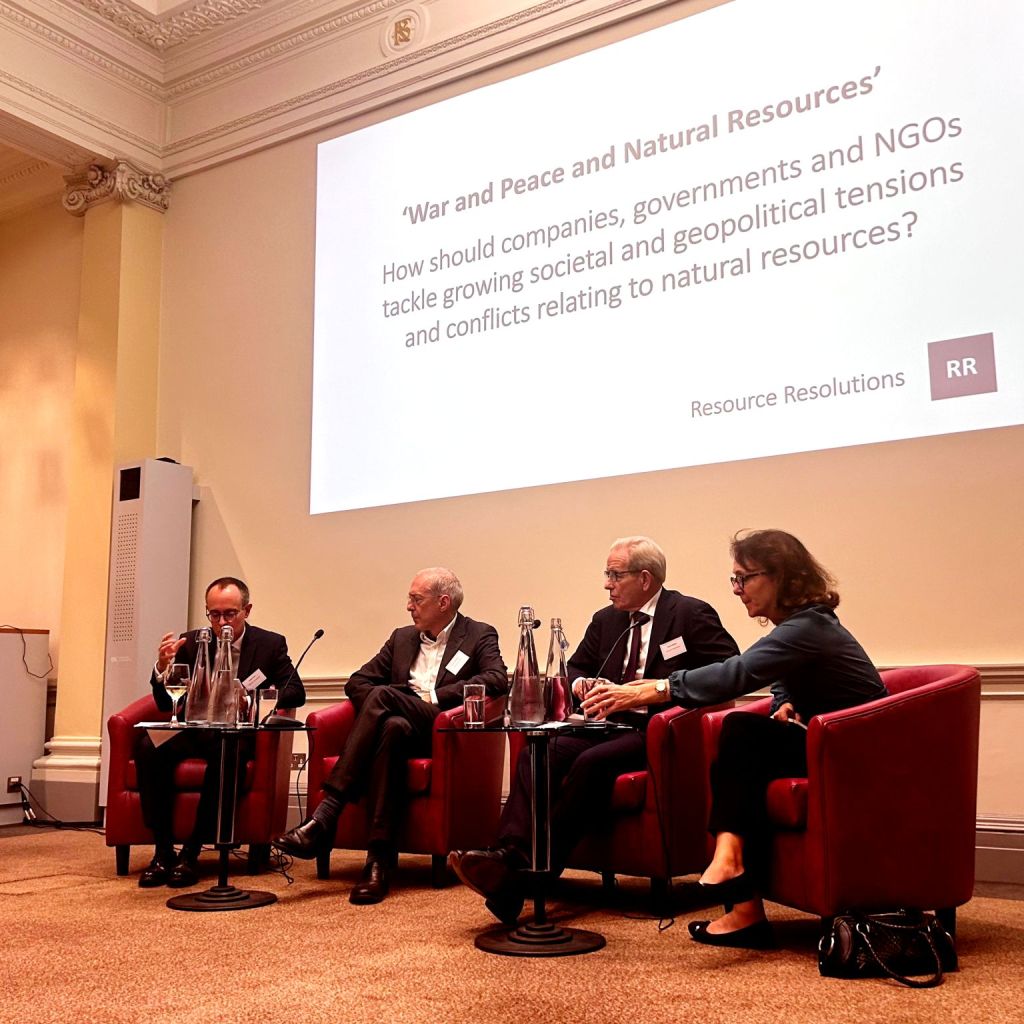
This note provides a summary of the discussion at an event held by Resource Resolutions on 23 October 2024. At the event, Dr. Karin von Hippel (Director-General of the Royal United Services Institute – RUSI), Chad Holliday (former Chairman of Shell, former Chairman of Bank of America, and former Chairman of the World Business Council for Sustainable Business), and David Nussbaum (Chair of International Alert, former CEO of the Elders Foundation and former CEO of WWF-UK) discussed the question: “how should companies, governments, and NGOs tackle growing societal and geopolitical tensions relating to natural resources?”
The event was attended by a range of experts and leading figures from industry, academia, think tanks and civil society. Please note the event was held under the Chatham House Rule and this note does not attribute comments from the discussion to individual speakers or guests.
Written by Chris Melville, co-Founder of Resource Resolutions
The post-World War II rules-based order has broken down; new rules for international cooperation and conflict resolution have yet to emerge
- With violent conflicts proliferating around the world and the influence of international institutions dissolving, the rules-based international order established in the aftermath of World War II is no longer the dominant framework governing international relations.
- A new order has yet to emerge to replace it. Instead, the world faces a much more fluid and competitive international landscape, characterised by multipolarity, emerging powers, divergent values, more assertive nationalism and significant shifts in economic power and prospects.
- In the face of these dynamics, it appears increasingly difficult for peacebuilding institutions to address emerging global threats, including the return of inter-state conflict, the proliferation of armed violence, climate change and pandemics.
With eroding international guardrails, geopolitical competition has more quickly turned to conflict
- In today’s landscape, geopolitical competition is turning ever more quickly to violent conflict and the pursuit of zero-sum objectives. Today’s conflicts are also becoming far more complex and intractable – from Sudan, to Syria, to Ukraine and Burma, major powers are no longer willing or able to hold the ring. They are instead actively intervening to influence outcomes whether to promote their own interests or to constrain the growth and power projection of rising middle powers.
- Such great- and middle-power strategies are acting as accelerants for deepening local conflicts, especially in developing countries, where socio-economic and political tensions are themselves being stoked by climate stresses, weak governance, inequality and poverty. In some cases, multipolarity and asymmetrical competition is producing conflict dynamics akin to an earlier phase of colonial competition and intervention – most notably, in the form of Russia’s Wagner Group/Africa Corps.
Access to natural resources is becoming a key frontier of international competition and conflict
- Access to and control over resources have always been a major factor in geopolitics: the outgoing post-war order was itself at least partly underpinned by the West’s desire and ability to control and cheaply exploit hydrocarbon resources from producer countries in the developing world.
- However, geopolitical competition around resources is today increasing, with the previous hegemonic arrangement under strain, the future of the fossil fuel economy itself in question, and consumer countries’ renewed desire to secure control over the critical minerals that will underpin the high-tech economies of the future.
- At the same time, increased competition among consumer countries is giving rise in some quarters to more assertive behaviour from producer countries looking to maximise the benefits of their resource endowment and to move up the industrial value chain.
- These producer demands have often been amplified and supported by civil society at local and international level who are advocating for a just transition for developing countries. However, consensus among civil society advocates is also breaking down, undermining the constructive potential of civil society in shaping the emergence of new governance arrangements.
- Meanwhile, resource companies – so often the critical linkages in globalised natural resource supply chains – are increasingly being caught in the middle, between the increasing and now often conflicting expectations and demands of home governments, host governments, consumers and society.
New approaches to building trust and managing divergent interests will be needed to avoid the most destructive conflict and work towards equitable resource development
- It is unlikely that any new ‘order’ for global cooperation and conflict resolution will emerge through the creation of an all-encompassing, top-down institutional architecture of the type established in the second half of the 20th century. Multipolarity, divergent value systems and varying economic and political models make it difficult to imagine such an architecture, let alone implement it.
- In this context, reducing destructive conflict around natural resources will rely more on the incremental rebuilding of trust at local, national and global scales; developing the ability to co-exist across differences; and making a new commitment to unearthing the win-wins inherent in collaborative natural resource development.
- Among big consumer countries/blocs – most notably the US, EU and China – this means seeking to foster dialogue and build mutual recognition of the potentially harmful consequences of trying to create integrated and exclusive resource supply chains. While the pursuit of resource security and autonomy appears rational in a context of fears about the geopolitical intentions of global peers, there is a danger that such resource security initiatives serve to balkanise resource flows and aggravate real security risks.
- As potential ‘linking’ actors, resource companies may have a role to play in fostering this dialogue and continued communication between powers, albeit quietly and with a focus on bringing their understanding of global resource needs to bear. More substantively, resource companies and producing countries will need to explore new ways of ‘sharing the pie’.
- While imperfect, Chinese investments in resources over the past twenty years have highlighted the limitations of earlier models in meeting the needs of host countries. New mechanisms will need to be developed – beyond standard methods of consultation – to ensure that host country development needs and community interests and rights are heard and balanced alongside market needs in long-term resource development strategies.
- To achieve this, governments, companies and civil society may have to re-evaluate their ‘red lines’ – the boundaries they impose to seek to structure other actors’ conduct – and to enter into much more pragmatic, flexible and adaptive dialogue to avoid escalating tensions, identify off-ramps and ensure more balanced and equitable development of the world’s natural resources.
 Resource Resolutions