
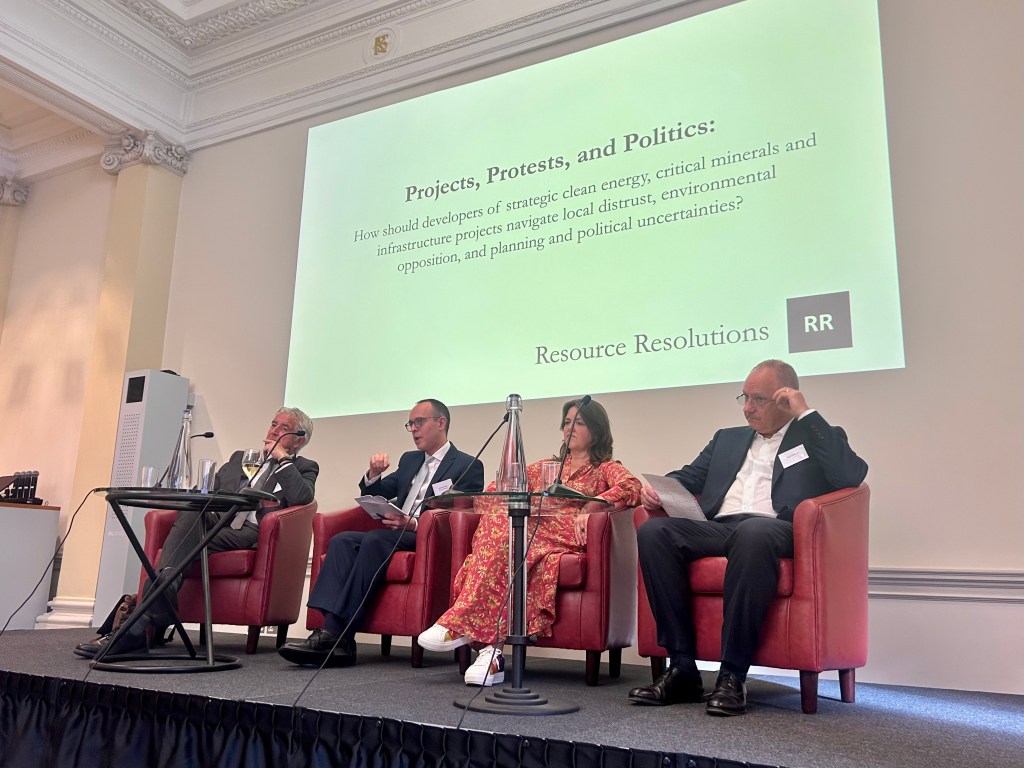
This note provides a summary of the discussion at an event held by Resource Resolutions (RR) on 25 June 2025. At the event, Julia Pyke (MD of the UK’s Sizewell C nuclear power project) Dr. Tony Juniper (Chair of Natural England; former Executive Director of Friends of the Earth) and Mark Cutifani CBE (former CEO of Anglo American; former Chair of Vale Base Metals) discussed the question: “How should developers of strategic clean energy, critical minerals and infrastructure projects navigate local distrust, environmental opposition, and planning and political uncertainties?“. The note was prepared by RR Co-Founder and Head of Operations Chris Melville. The event was attended by a range of experts and leading figures from industry, academia, think tanks and civil society. Please note the event was held under the Chatham House Rule and this note does not attribute comments from the discussion to individual speakers or guests.
Local distrust and opposition pose an existential challenge to the rollout of strategic clean energy, critical minerals and infrastructure projects
- From the high Andes to rural England, local resistance to the siting of strategic energy and natural resource projects is posing an increasingly significant challenge to project developers.
- Amid government and business efforts to accelerate investments in clean energy infrastructure and critical minerals supply chains, local communities and environmental organisations are seeking more than ever to assert control over decisions impacting their lives and interests.
- While local opposition has often been a factor shaping such projects in the past, there is a sense that such ‘friction’ around projects is becoming more frequent and ubiquitous, driven by decreasing levels of trust in ‘expert’ knowledge and authority, social fragmentation, political polarisation and unfettered flows of information and opinion.
- In this new context, creative approaches will be needed to find common ground, build sound understanding of the issues at stake and generate alignment around the pace and direction of energy and resource development.
Project promoters need to ‘tell their story better’, but resolving differences also means actually listening to public concerns
- Adverse attitudes towards natural resource development are often underpinned by a lack of public understanding about the role that natural resources and materials play in sustaining growth and human well-being. There is clearly a pressing need for the energy and resources industry as a whole to seek to broaden this understanding.
- For example, the mining industry is commonly perceived as land-greedy and a threat to land-based livelihoods but the industry not effectively communicated the messages that it occupies only 0.3% of the earth’s surface and – through supply of modern fertilisers – significantly reduces the physical footprint of agricultural land required to supply food to the global population.
- While project developers need to share such messages more widely, they also need to recognise that improved public understanding of the rationale for energy and resource development cannot automatically ‘explain away’ the real concerns that people often have about the impact and consequences of specific infrastructure development in their local areas.
- If the public does not have a robust understanding of the ‘macro’ role played by energy and minerals, they most certainly do not lack understanding of what they value in their local environment and what they are willing to protect from perceived threats.
- Disparaging project opponents as ‘NIMBYs’ – implying selfishness in the face of a self-evident public interest – is unhelpful and only aggravates the sense of unfairness in some project-hosting communities that someone else is benefiting at their expense.
- By contrast, acknowledging local concerns about project-induced change is a critical first step to building trust with a potentially suspicious community. While concerns about impacts on the local environment, livelihoods and local character are frequently at the centre of contention, these concerns are often amplified by people’s feelings of exclusion from decision making and their sense that their voices are not being heard.
Planning processes often drive developers and communities into confrontation…
- Frustratingly, most conventional planning processes – whether a developer-led environmental impact assessment or local authority-led planning application processes – can set developers, communities and environmental organisations on the path of confrontation.
- For example, ‘consultation’ processes – in which project information is shared with stakeholders and feedback is received from them – often take place relatively late in the project development cycle. By this time, key project decisions have been already taken and engineers have become invested in a particular technical scheme, incentivising developers to adopt defensive positions towards the articulation of community concerns.
- Similarly, many public hearings are explicitly set up to hear evidence from project ‘proponents’ and project ‘opponents’. Such settings can create an “either/or” framing for energy and resource development – i.e. either we de-carbonise the grid or we can protect the character, lifeways and livelihoods of project-affected communities.
- Moderate perspectives – which look to balance development and environmental/community needs – are often silenced in such confrontational processes.
- Misalignment can also be found at a strategic policy level. Lack of coordination between agencies can result, for example, in a swamping of projects in a particular area. Likewise, opportunities for sub-sectoral cooperation and more holistic regional planning are missed.
… but early dialogue and a synergy-focused mindset can produce better outcomes
- Dialogue and consultation processes that are superficial and those which are deep look the same on the surface, but there’s a huge difference. To identify real win-wins, real synergies, developers need to speak to people at the beginning; to listen and engage with what people care about and to participate in a process of co-design and trust building.
- In many cases, happily, energy and resource development need not lead to zero-sum trade-offs between growth and environment or growth and community. Alternative “both-and” framings are often available for developers with imagination and commitment.
- The case of new housing development in the UK’s Thames Basin Heaths is a good example of such synergy seeking at work. Initially opposed because of the negative impact of increased population on heathland wildlife habitats, the developer worked with environmental organisations and local authorities to develop a scheme that would create alternative green spaces for walking and reduce pressure on habitats. The result was both 50,000 new homes built and an increase in the bird population.
- A synergy-seeking mindset was also evident in the case of the Quellaveco copper-gold mine in Peru. Initially opposed by farming communities for its anticipated impact on an agricultural water reserve, the project developer – Anglo American – worked over 18 months with communities and provincial authorities to develop a scheme that would result in a net increase in water resources available to local farmers.
- The examples above are evidently very different from the transactional trade-offs that are sometimes used to ‘buy support’, such as the infamous £100m+ ‘bat tunnel’ implemented for the UK’s High Speed 2 (HS2) rail project. In this case, earlier integration of nature interests in decision making around route siting could have resulted in lower costs, better outcomes and less reputational damage for the developer.
 Resource Resolutions