
RR recently undertook a research ‘pilot project’ around a major UK solar project which offers important lessons for renewables projects facing opposition globally. Our research found deep divisions but also scope for independently facilitated dialogue to help address rising distrust.
By Chris Melville and Ben Macleod
The United Kingdom is facing a paradox that is threatening its net zero ambitions. While 80% of the public supports renewable energy, local authority refusal rates for solar projects are rising and, around large-scale Nationally Significant Infrastructure Projects (NSIPs), opposition campaigns are becoming much more sophisticated, interconnected and vocal.
In a moment when the government is accelerating towards Clean Power 2030, trust in how decisions are made is falling. In November 2025, RR undertook a research ‘pilot project’ to explore whether independently facilitated dialogue around renewables projects might help to build trust and bridge divides. While the research focused on the UK situation, our findings have broader implications for renewables development around the world, particularly those that are facing growing community level opposition.
Context: Mind the (legitimacy) gap
Over the past five years, the UK has dramatically accelerated renewable energy deployment. Installed capacity has increased by roughly 30% since 2020, with renewables now overtaking fossil fuels in the electricity mix.
Yet this national success masks a troubling local dynamic. In rural renewable energy ‘hotspots’ – particularly the East Midlands, East Anglia and parts of Scotland – communities are experiencing a wave of large-scale renewable infrastructure projects. In some regions, multiple projects are concentrated in the same area, giving rise to community concerns – and increasingly anger – about cumulative landscape industrialisation, agricultural land loss, and the disproportionate burden on rural communities.
All the rage: examples of recent UK headlines about local opposition to renewable energy infrastructure
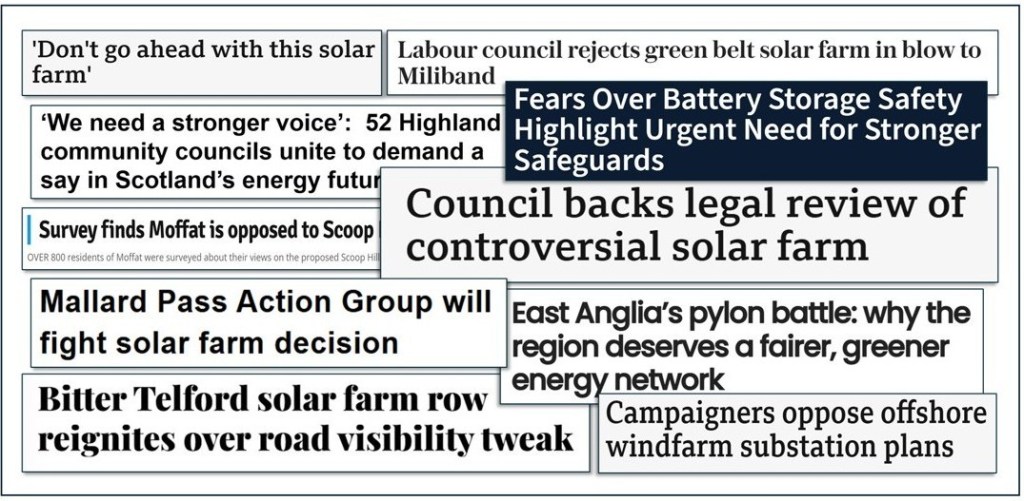
Community frustration is amplified by the fact that for renewable energy NSIPs – the largest renewable energy projects with the greatest potential impacts – final decision-making power rests with the national government rather than with local councils. Since almost all NSIPs are approved by central government, regardless of any local opposition, this has created a widespread perception among project-affected communities that statutory public consultation undertaken by developers is performative – a box-ticking exercise designed to legitimise predetermined outcomes.
Without what they see as meaningful influence over planning outcomes, communities are increasingly mobilising in opposition. Many developers we have spoken to suggest that while organised opposition was once rare, it is now increasingly common, marked by anger and sometimes low-level violence.
This issue goes beyond specific projects. In many parts of the UK, populist political movements are capitalising on local discontent, adopting anti-renewables platforms to harness rural grievances. Without rebuilding trust in how decisions are made, the political consensus on net zero itself could fray.
RR’s research ‘pilot project’
Resource Resolutions (RR) is an independent venture established to address division and build alignment around energy and natural resource development. We are not lobbyists or PR consultants, but an impartial mediating body dedicated to bridging divides and, where possible, identifying mutually beneficial resolutions. Drawing on our team’s experience across scores of complex energy and natural resource disputes globally, we design innovative dialogue processes rooted in stakeholders’ genuine needs and interests.
We are currently exploring whether these proven international conflict resolution techniques might apply in the context of growing distrust and division around the UK renewables sector and thereby help developers and communities navigate deepening divisions to achieve better, more sustainable outcomes.
To this end, RR recently undertook a research ‘pilot project’ to examine how these dynamics were showing up around a large solar energy project in Lincolnshire – an English county that has seen a relatively high concentration of planned and approved energy infrastructure projects and where there has been relatively coordinated opposition to our focus project and others recently approved or going through planning.
In November and December 2025, our team held a series of meetings with a range of key stakeholders affected by our focus project, including the developer, district and parish councils, action groups, local businesses, community associations and clubs, and individual residents. Through these meetings, we hoped to build a deeper understanding of the broad set of interests and positions among key stakeholders, and to explore whether independently facilitated dialogue – running alongside formal statutory consultation – might help to build trust around renewable energy projects.
Our key findings:
- Stakeholder dynamics around our focus project reflected the broader trend of deepening division. In line with the national data, our interviews in Lincolnshire suggested that most community stakeholders around our focus project are not ideologically opposed to solar energy – many acknowledged the importance of decarbonisation and the role solar energy can play in that. However, almost all the stakeholders we spoke to expressed opposition to the project and other nearby renewable energy developments, some with resignation or pragmatism, others with a commitment to active opposition and mobilisation.
- Surface disagreements are often driven by much deeper concerns. Our interviews suggested that opposition stems from three primary factors: a perceived lack of influence over decision making affecting people’s lives; concerns about the cumulative regional impact of solar development on landscape, heritage and local culture; and the view that community consultation around projects is fundamentally performative.
- Standard consultation is necessary but insufficient. Developers sometimes exceed statutory consultation requirements – and the developer of our focus project is committed to doing this in many respects – yet communities still report feeling powerless and unheard. The problem is not necessarily the quantity of engagement but the quality of conversations that standard consultation allows – consultation extracts opinions on predetermined proposals rather than creating space for genuine dialogue about whether and how projects can work for communities.
- Independently facilitated dialogue offers a third way. Between blanket opposition, resigned pragmatism and passive acceptance lies a more productive path: structured conversation convened by a trusted facilitator with no stake in the outcome. This approach establishes common facts, surfaces underlying interests rather than entrenched positions, and identifies opportunities for mutual gain that adversarial processes obscure.
- International case studies suggest this works. Our Lincolnshire research reveals significant divisions – but also untapped potential for collaboration if stakeholders can engage differently. International experience, including from Europe, demonstrates that independently facilitated dialogue can reduce opposition, make planning less problematic, and produce better outcomes for all parties.
- There is a real need to restore trust in renewable energy planning. Without restoring trust in decision-making, those promoting the energy transition will encounter increasing challenges and consensus around the UK’s energy future will remain elusive.
Implications for the UK renewables sector
- For developers: For developers, independently facilitated dialogue is not an additional cost – it is an investment in project viability. It can reduce planning risk, protect reputation and improve project outcomes without delaying projects.
- For communities: For communities, independently facilitated dialogue restores a sense of fairness and can generate more influence over project design and benefit distribution.
- For local authorities: Independently facilitated dialogue can help to align projects with regional development needs and community concerns while meeting local authority goals for renewable energy development.
- For policymakers: For policymakers, it offers a pathway to deliver essential infrastructure while maintaining democratic legitimacy at a time when the window for rebuilding trust is narrowing.
The challenge of the energy transition is also a legitimacy challenge. Without embedding independent facilitation as good practice in renewable energy planning processes – particularly in regions facing cumulative impacts – the real bottleneck in clean power ambitions will not be the planning process but fraying community consent and the erosion of consensus around the transition to clean energy.
Implications for global renewables
Our findings should resonate globally. From Germany to Brazil to Australia, renewable energy projects encounter strikingly similar patterns: national net zero commitments, strong public support in principle, yet persistent local opposition driven by fairness and process concerns.
The good news: proven approaches to building alignment exist. Independent facilitation has demonstrated effectiveness across dozens of complex energy disputes – from hydropower in Nepal to transmission lines in Bavaria. These approaches surface legitimate concerns, identify creative solutions, and rebuild trust in deep conflict.
The UK case is instructive because it demonstrates these tensions at the frontier of energy transition in a wealthy, stable democracy with an established planning frameworks. If we address the legitimacy deficit here – by mainstreaming independent facilitation as standard practice – the lessons will apply directly to renewable deployment challenges in comparable jurisdictions globally.
Resource Resolutions works with developers, local authorities, policymakers, and communities to design and deliver dialogue processes that can help to rebuild trust and improve outcomes around energy development.
If you would like to receive a copy of the full paper, please email us at info@resource-resolutions.com with your name, organisation and contact details. For enquiries about applying these approaches, please contact us.
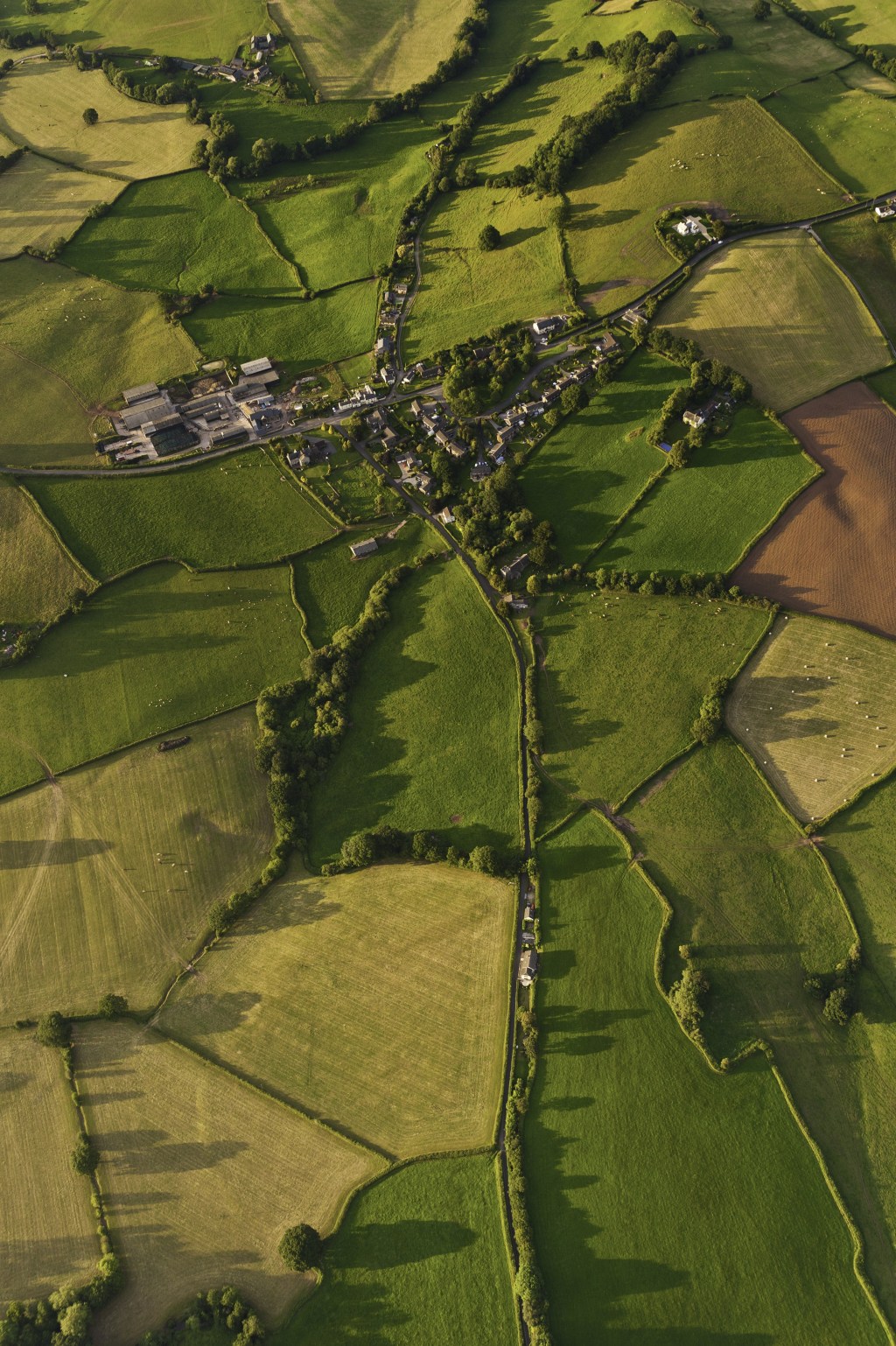
Image: Patchwork landscape village – 155145455
 Resource Resolutions